PROJECT EXPLANATION
For my 1984 project, I really wanted to be able to do something in which I could incorporate the themes of choosing between conformity and rebellion, and what comes with those choices. I wanted to be able to incorporate the idea of being watched, that you must follow the rules, or risk the consequences, just like “The Game” did. To do this, I thought it would be fun to make a game in which you live a day in the life of Winston. You would wake up in Victory Mansion, go to work at the Ministry of Truth, and experience Winston’s job of updating old media to match the Party’s agenda, all while trying to avoid raising suspicion.
In the specifics of the game itself, I decided to make it somewhat like a “choose your own adventure” game by giving the player options on how to respond to events and letting those responses dictate your success in the game. My reasoning behind making the game like this was that I wanted to include the themes of censorship and surveillance. I wanted to find a way to capitalize on how, in Oceania, everything you say and do matters; a few slip ups here and there may be fine, however, if you’re careless, those slip ups can have repercussions. That is why I included Big Brother, and the suspicion bar, to measure how well, or poorly, you are following the rules. I attempted to make this as similar to Winston’s experience as possible while still staying true to keeping it as a satirical representation.
Some specific features from the book that I included —other than the obvious ones like the characters, locations, 2 minute hate, etc.— were the memory hole, the chocolate rations telescreen announcement, the propaganda posters, and the specific projects being worked on in the ministry. My game is not a specific event that happened in the book; this game is occurring before the events in the story, and because of this I didn’t include specific quotes by characters into the dialog. Instead, I included text from the book that relates to specific portions in the game, and displayed them on the screen at those times. By doing this, I was able to create my own storyline while still including specific text evidence from 1984.
(I am not going to go into every example of this, or explain every connection in the game because when playing through the game they are clear and easy to find if you have read the book. However I will go over one example so that I can show the general idea of what I was going for in these connections.)
During the 2 minute hate in 1984, a blowlamp is used as a metaphor for how the Party engineers this intensely concentrated hate that the Party designs to be pointed to specific targets. The blowlamp can be seen in the fiery hate Winston feels during the broadcast, and how he feels the need to direct it at someone. In the game, during its own production of the two minute hate, the narration and response choices reference the metaphor of the blowlamp by emphasising those specific aspects of the ‘Hate’s’ design. When the Hate first begins, the narration describes the hate as “an abstract, undirected hate, looking for somewhere to land,” and through the choices, the idea of the blowlamp is further emphasized by making the player choose where they point their hate.
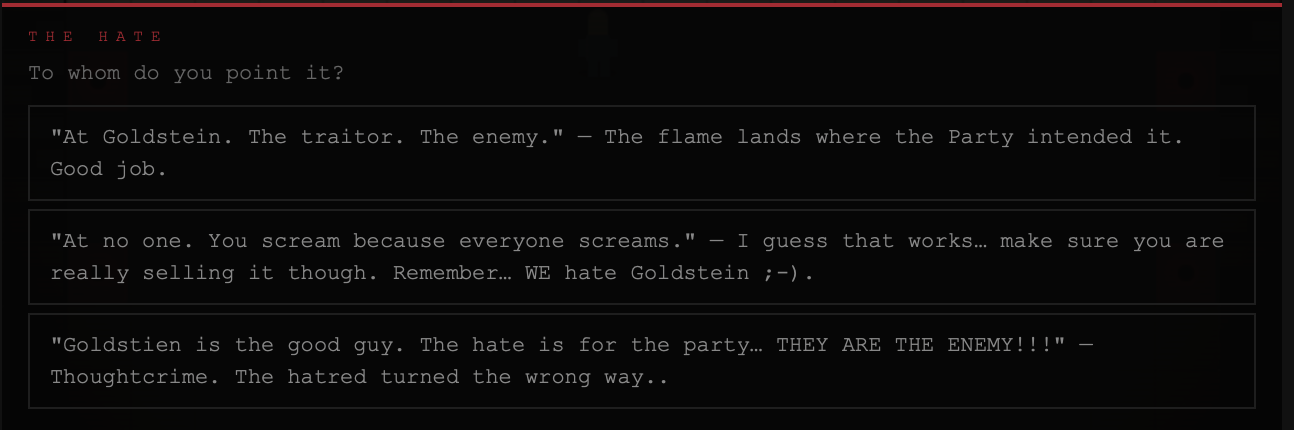
Additionally I put the 1984 text evidence of the blowlamp metaphor at the top right of that scene to make the connection more clear.

In my opinion, this idea, the choice between being true to what you believe versus conforming to what others will approve of, is something that is not unique to 1984 by any means, and it is something that is very prevalent in today’s society that needs to be addressed more. While, in our society, we are not at risk of being taken by the government and tortured for having unpopular opinions, censorship is still a huge issue. Even though it’s not as extreme as 1984, people still hide what they believe in purely out of fear of judgement by society, and in recent times I feel this has become a lot more prevalent as political polarization and lack of exposure to differing opinions has resulted in people thinking it is okay to hate, and even harm, people who share a different point of view. Because of this, while my game is just a lighthearted parody, I truly believe that the ideas behind it, the themes it represents, are ones that go beyond the story of 1984 and are deeply relevant to the society we live in today.